
Reviewed by a licensed veterinarian. Information in this article is based on guidelines from the VCA Animal Hospitals, Cornell University College of Veterinary Medicine, and the American Kennel Club (AKC).
If you suspect your dog is pregnant, the first question on your mind is probably: how long is a dog pregnant? The short answer is about 63 days — roughly nine weeks from ovulation to delivery. But that timeline comes with important nuances every dog owner should understand.
This vet-reviewed guide covers the full dog pregnancy journey: what’s happening inside your dog week by week, which symptoms to expect, how to confirm pregnancy, what to do if labor goes wrong, and how to care for your dog and her puppies after birth.
The Dog Gestation Period — What the Numbers Mean
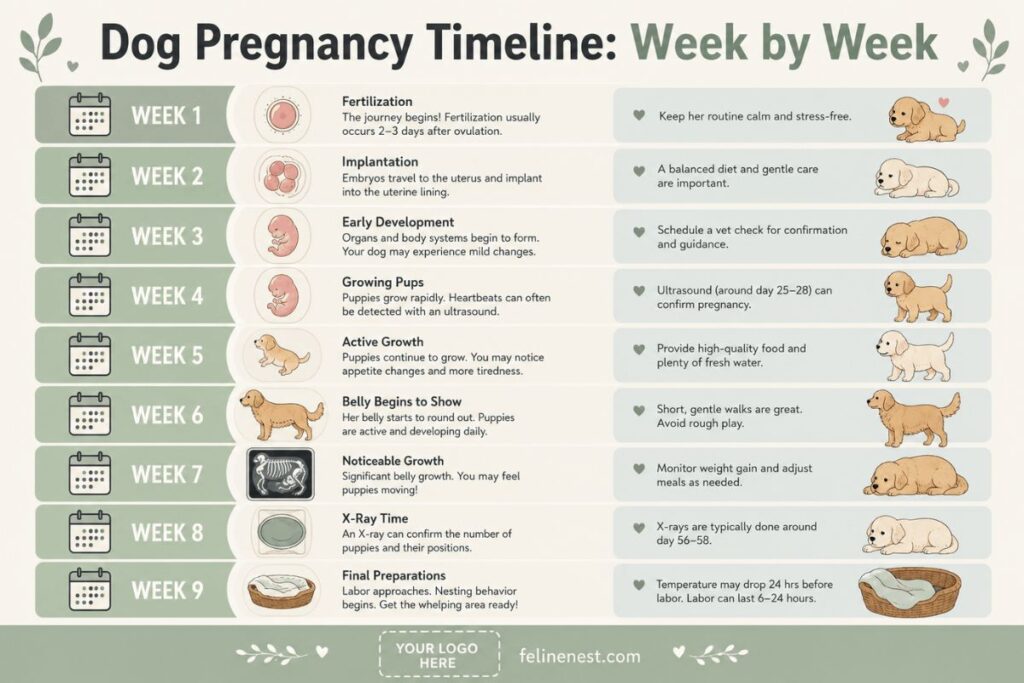
The average canine gestation period is 63 days from ovulation, which translates to approximately nine weeks or just over two months. The full range spans 57 to 72 days, depending on several biological factors.
Veterinarians count the pregnancy from the date of ovulation — not always the date of breeding. This distinction matters more than most dog owners realize.
| Measurement Method | Typical Timeframe | Accuracy |
| From breeding date | 58–68 days | Less accurate — often off by 5–7 days |
| From ovulation date | 63 days | Most accurate |
| From fertilization | 57–65 days | Variable |
| If past this point, see your vet | 70+ days | Emergency threshold |
Why 63 Days Isn’t Always Exact
A male dog’s sperm can survive inside the female reproductive tract for several days after mating. Once a female dog ovulates, the egg also needs two to three more days to mature before fertilization can occur.
This means your dog could mate on day one but not actually conceive until several days later. That’s why using the breeding date alone to calculate a due date can be off by a week or more. Veterinarians use progesterone hormone testing to pinpoint ovulation and give a more precise due date.
Does Breed or Litter Size Affect How Long a Dog Is Pregnant?
Yes — slightly. Smaller breeds tend to deliver a little earlier, while larger breeds may stay pregnant closer to the upper end of the range.
| Factor | Effect on Pregnancy Length |
| Small breed (Chihuahua, Pomeranian) | Slightly shorter — closer to 58–61 days |
| Large breed (Labrador, German Shepherd) | Slightly longer — closer to 63–65 days |
| Large litter (6+ puppies) | Often delivers a few days earlier |
| Small litter (1–2 pups) | May carry closer to day 65–68 |
| Bulldog / Brachycephalic breeds | Higher C-section risk; vet monitoring essential |
The variation is generally a few days at most. If your dog goes past 70 days without delivering, contact your vet immediately — this is a medical emergency.
Dog Pregnancy Stages — Trimester by Trimester
Like human pregnancies, dog pregnancy is divided into three trimesters. Each lasts approximately three weeks. Because the timeline is so condensed, changes happen quickly, and veterinary monitoring is essential.
First Trimester (Weeks 1–3): Subtle and Easy to Miss
During the first three weeks, most dogs show no obvious signs of pregnancy at all. The embryos are just beginning to form and implant into the uterine wall around day 16–18.
Some dogs experience mild morning sickness around weeks two to three — occasional nausea, reduced appetite, or low energy. You might also notice your dog becoming slightly more affectionate or seeking more rest than usual.
Do not increase her food yet. According to VCA Animal Hospitals, overfeeding in early pregnancy actually increases the risk of birthing complications.
Second Trimester (Weeks 4–6): Changes You Can See
This is when dog pregnancy becomes real and visible. Most owners first notice something is different during week four or five.
Around day 25–28, a veterinary ultrasound can confirm the pregnancy and detect fetal heartbeats. Your dog’s nipples will begin to enlarge and may take on a pinkish or darker hue — one of the earliest physical signs owners spot.
By week five, abdominal swelling becomes noticeable and your dog will start gaining weight — typically 15–25% above her pre-pregnancy weight by the end of the second trimester. She may also experience a short bout of “morning sickness” around days 30–35.
Starting around week five, gradually transition her to a high-quality puppy food formula rich in protein, calcium, and omega-3 DHA. Look for an AAFCO label stating the food is appropriate for “gestation and lactation” or “all life stages.”
Third Trimester (Weeks 7–9): Getting Ready for Birth
The third trimester is the most dramatic phase. Your dog’s abdomen grows significantly as the puppies develop rapidly. She may struggle to eat large meals — smaller, more frequent meals are much easier on her stomach.
By week seven, the puppies’ skeletons are visible on X-rays. Your vet may take X-rays at this point to count the litter and confirm proper positioning. Around week eight, nesting behavior begins — rearranging blankets, seeking quiet spots, or acting restless.
Signs labor is approaching within 24 hours:
- Body temperature drops below 100°F (normal is 101–102.5°F)
- Restlessness, pacing, or panting
- Loss of appetite completely
- Visible shivering or trembling
- Clear or white vaginal discharge
How to Confirm Your Dog Is Pregnant
You cannot reliably confirm dog pregnancy at home. Many signs overlap with false pregnancy (pseudopregnancy), which is surprisingly common. A vet visit is the only way to know for sure.
Vet Methods to Diagnose Dog Pregnancy
Veterinarians have four main tools to confirm and monitor canine pregnancy:
| Method | When It’s Used | What It Reveals | Accuracy |
| Relaxin hormone blood test | Day 21–25 after mating | Confirms pregnancy; may miss single-puppy litters | Good for early detection |
| Abdominal palpation | Weeks 3–4 | Detects embryonic sacs; requires trained hands | Variable — depends on dog’s relaxation |
| Ultrasound | Day 25–35 | Confirms pregnancy, counts heartbeats, checks fetal health | Gold standard for early confirmation |
| X-Ray | Week 7 onward | Most accurate litter count; confirms puppy size and position | Best for late pregnancy |
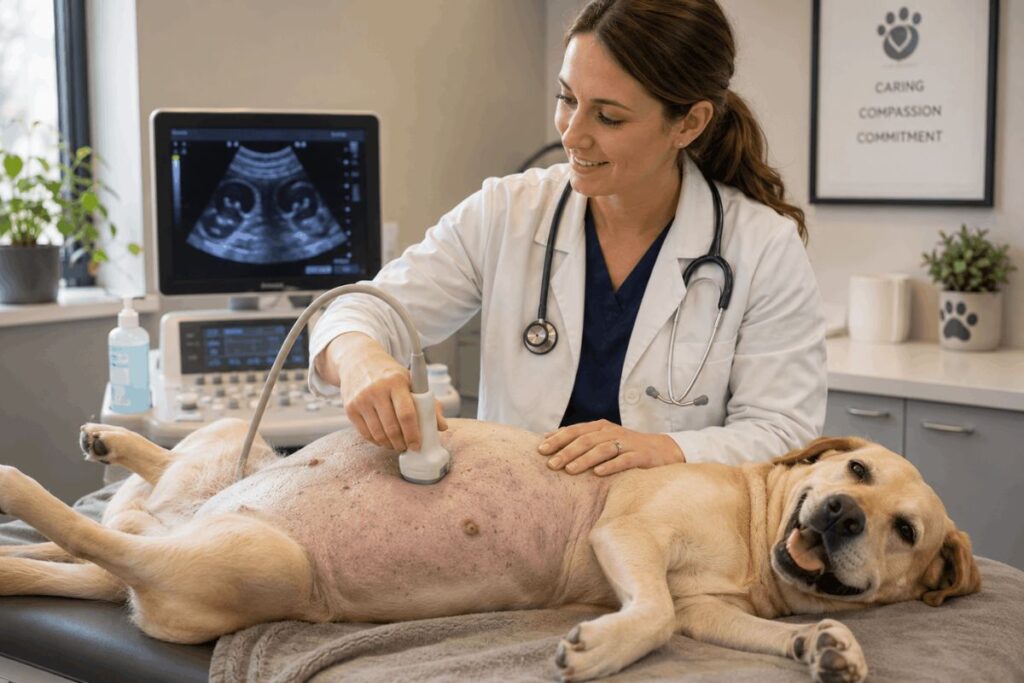
Ultrasound is the gold standard for early confirmation. X-rays are preferred later in pregnancy to count puppies accurately — knowing how many are expected helps you confirm all puppies have been safely delivered.
Caring for a Pregnant Dog — Nutrition and Exercise

A pregnant dog’s nutritional needs shift significantly as she progresses through each trimester. Cornell University’s veterinary guidelines recommend keeping her on a high-quality regular diet for the first four to five weeks, then gradually switching to a puppy food formula.
During the final three weeks, your dog may need up to 1.5 times her normal daily food intake. Break this into three to four smaller meals per day to reduce stomach pressure from the growing litter.
For exercise, gentle daily walks are beneficial throughout most of the pregnancy. Avoid strenuous activity, jumping, rough play, and contact with unfamiliar dogs — especially in the final trimester. Let her energy levels guide her activity.
Set up a warm, quiet whelping box several weeks before her due date. Line it with clean bedding and place it somewhere private. Introduce her to it early so it feels safe and familiar when labor begins.
⚠️ Warning Signs During Labor — When to Call Your Vet Immediately
This section is what most dog pregnancy articles skip — and what every dog owner actually needs to know. Labor complications are more common than people expect. Knowing the red flags can save your dog’s life and the lives of her puppies.
Veterinarians consider the following situations emergencies requiring immediate veterinary care:
| Warning Sign | What It May Indicate | Action |
| Active straining for 20–30 min with no puppy | Puppy stuck in birth canal (dystocia) | Emergency vet — do not wait |
| More than 2 hours between puppies | Uterine inertia or blocked pup | Call vet immediately |
| Green or black discharge before any puppy is born | Placental separation without delivery | Emergency — call vet now |
| Foul-smelling discharge at any point | Infection (pyometra risk) | Vet visit same day |
| Mother collapses, trembles, or has seizures | Eclampsia (milk fever / calcium crash) | Emergency — life-threatening |
| A puppy appears partially delivered but won’t come out | Malpresentation or stuck pup | Emergency vet only |
| Labor stops completely before all puppies are born | Secondary uterine inertia | Call vet immediately |
Do not attempt to pull out a stuck puppy yourself. Dogs often give birth at night — know your nearest 24-hour emergency vet clinic before her due date. It’s always better to call and be told everything is fine than to wait and lose a puppy or the mother.
After Birth: What to Expect in the First 2 Weeks
Many dog owners are well-prepared for the pregnancy — but have no idea what normal looks like in the days after delivery. This is where important signs get missed.
Normal Postpartum Signs in the Mother
After delivering all puppies and their placentas, your dog will be tired but alert. She will instinctively begin cleaning her puppies and nursing them within the first hour.
A dark red or greenish-brown vaginal discharge (called lochia) is completely normal for up to three weeks after birth. This is the uterus cleaning itself. It should gradually decrease in volume and lighten in color over time.
| Postpartum Sign | Normal | See a Vet If… |
| Vaginal discharge (lochia) | Dark red/brown, decreasing over 1–3 weeks | Foul smell, bright red, increasing in volume |
| Appetite | Returns within 24 hours; increases significantly | Not eating after 24 hours |
| Milk production | Begins within 24–48 hours of birth | Mammary glands hot, swollen, or painful (mastitis) |
| Energy level | Tired but attentive to puppies | Extremely lethargic or unresponsive |
| Temperature | Returns to normal (101–102.5°F) | Fever above 103°F — may signal infection |
Keep the mother warm, well-fed, and away from other pets for the first two weeks. She needs peace to bond with and nurse her litter.
Caring for Newborn Puppies

Newborn puppies are completely helpless. They cannot regulate their body temperature, so they depend entirely on their mother and environment for warmth.
For the first week, the whelping area should be kept at 85–90°F. This can be reduced gradually as the puppies grow. Make sure all puppies are nursing — each one should feed every one to two hours in the first days of life.
Weigh each puppy daily for the first two weeks. A healthy puppy gains weight every single day. If a puppy loses weight two days in a row, contact your veterinarian — it may need supplemental feeding.
Do not send puppies to their new homes until they are at least 8 weeks old. Many vets and breeders recommend waiting until 10–12 weeks for optimal social development.
Frequently Asked Questions
Q: How long is a dog pregnant in months?
A dog is pregnant for approximately two months — about 63 days, just over the two-month mark.
Q: What are the first signs that a dog is pregnant?
Early signs include mild appetite changes, slight lethargy, nipple enlargement or pinking, and occasional nausea around weeks two to three. Many dogs show no signs at all in the first few weeks.
Q: Can I tell if my dog is pregnant at home?
You cannot reliably confirm pregnancy at home. Dogs can experience false pregnancies that mimic real pregnancy symptoms. Only a vet can confirm through ultrasound or hormone testing.
Q: How long does dog labor last?
Active dog labor typically lasts six to twelve hours. Each puppy is usually born within 30 to 60 minutes of one another. Contact your vet immediately if more than two hours pass between puppies.
Q: When should I take my pregnant dog to the vet?
Take her to the vet two to three weeks after mating for a hormone test, around weeks four to five for an ultrasound, and again around week seven for an X-ray to count puppies.
Q: What should I feed a pregnant dog?
Keep her on a high-quality regular diet for the first four to five weeks, then gradually switch to a puppy food formula (or food labeled “all life stages” per AAFCO). Increase meal frequency and portion size in the final three weeks.
Q: How many puppies can a dog have?
Litter size varies widely by breed. Small breeds typically have one to four puppies; large breeds can have eight or more. An X-ray at week seven is the most accurate way to determine litter size.
Q: What is normal after a dog gives birth?
Dark reddish-brown discharge for one to three weeks is normal. The mother should begin nursing and cleaning her puppies immediately. Her appetite will return and increase significantly within 24 hours of delivery.
Final Thoughts — Supporting Your Dog Through Pregnancy
Understanding how long a dog is pregnant — and what to expect at each stage — puts you in the best position to support her through this incredible process. The 63-day canine gestation period moves fast, and each trimester brings meaningful changes that signal a healthy pregnancy progressing on track.
Get your vet involved early, set up a comfortable whelping space in advance, adjust her diet as she moves through each trimester, and know the warning signs that need immediate attention. The more prepared you are, the more confidently you can respond if anything unexpected happens during labor or in those critical first two weeks after birth.
For more vet-backed dog health tips, breeding guides, and puppy care articles, explore the rest of our blog!