
Your dog is lying still, eyes glazed, not interested in dinner. Something feels off. Knowing how to tell if a dog has a fever could be the difference between catching a problem early and letting it get worse.
Dogs can’t tell us when they feel unwell. So it’s up to you to spot the signs. This guide covers 7 key fever symptoms, how to safely check your dog’s temperature at home, what causes fever in dogs, and exactly when to call the vet.
What Is a Normal Dog Temperature?
Before you can identify a fever, you need to know what’s normal. A healthy dog’s body temperature sits between 101°F and 102.5°F — significantly higher than the average human temperature of 98.6°F.
Anything above 103°F is considered a fever in dogs. A reading of 106°F or higher is a medical emergency that can cause organ damage or death.
| Temperature Range | What It Means | Action Required |
| 99.5°F – 102.5°F | Normal range | No action needed |
| 102.6°F – 103°F | Slightly elevated | Monitor closely |
| 103°F – 104°F | Fever | Call your vet |
| 104°F – 106°F | High fever | Go to vet urgently |
| 106°F and above | Emergency | Emergency vet immediately |
Fever vs. Overheating — Key Difference
Many owners confuse fever with overheating, but they are very different. A fever is the body’s immune response to infection or illness — it comes from the inside. Overheating (hyperthermia) happens when a dog gets too hot from the environment, like staying in a car or exercising in the sun.
Both are serious, but the treatment is different. A fever requires a vet visit to find the underlying cause. Overheating requires immediate cooling and emergency care.
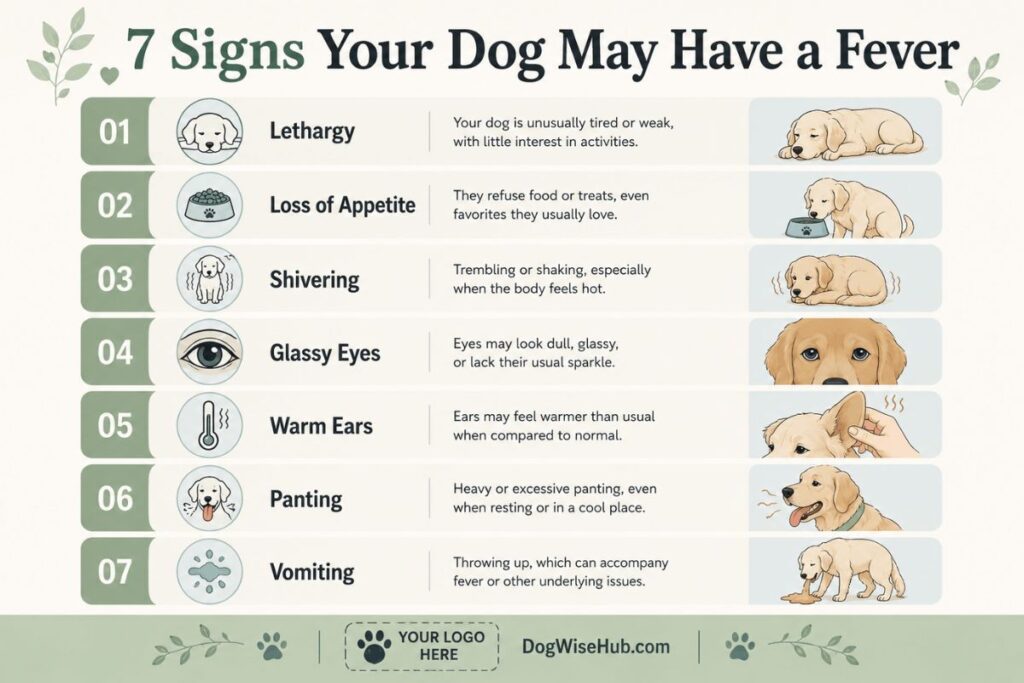
7 Signs That Tell You How to Tell If a Dog Has a Fever
Dogs show fever in behavioral and physical ways. Learning to tell if a dog has a fever starts with watching these signs carefully.
Behavioral Signs
Lethargy is one of the most reliable early clues. A normally energetic dog that suddenly wants to sleep all day and shows no interest in walks or play is a red flag.
Loss of appetite is another common sign. If your food-motivated dog is ignoring his favorite treat, something is wrong. This alone does not confirm a fever, but combined with other symptoms, it’s significant.
Withdrawal and hiding behavior can also occur. Dogs instinctively isolate themselves when they feel unwell — this is a protective instinct rooted in survival.
Physical Signs
| Physical Sign | What It Looks Like | Reliability |
| Warm or hot ears | Ears feel much warmer than usual | Moderate — not definitive alone |
| Shivering or trembling | Shaking despite being warm | High — key fever symptom |
| Glassy or red eyes | Eyes look watery, dull, or inflamed | High — often overlooked |
| Dry, warm nose | Nose dry and warmer than normal | Low — can be misleading |
| Nasal discharge | Runny nose or thick mucus | Moderate — sign of infection |
| Rapid panting | Breathing faster than normal | Moderate — also seen in heat |
| Vomiting | May occur with high fever | High — warrants vet visit |
Many people believe a warm, dry nose means a dog has a fever. Veterinarians advise against relying on this method — a dog’s nose can be warm simply because it’s been sleeping or the weather is dry. It is not a reliable test.
The only way to confirm a fever in dogs is to take their temperature with a thermometer.
How to Check Your Dog’s Temperature at Home

Once you notice symptoms, the next step is to confirm whether your dog has a fever. Veterinarians recommend using a digital thermometer — never an old mercury thermometer, which is no longer considered safe.
Rectal Thermometer — Step-by-Step
The rectal thermometer is the gold standard for accuracy. Here is how to use it safely:
| Step | What to Do |
| Step 1 | Wash the thermometer with soap and water, rinse, and dry |
| Step 2 | Apply petroleum jelly or a water-soluble lubricant to the tip |
| Step 3 | Have a second person hold your dog gently, lifting their tail |
| Step 4 | Insert the thermometer approximately 1 inch into the rectum |
| Step 5 | Wait for the digital beep, then remove carefully |
| Step 6 | Read the temperature and clean the thermometer after use |
If your dog’s temperature reads above 103°F, call your vet. If it reads 106°F or higher, go to an emergency animal clinic immediately.
Do not take your dog’s temperature right after exercise or excitement — activity can temporarily raise body temperature. Wait at least 10 minutes after physical activity before checking.
Ear Thermometer — When to Use It
Ear (aural) thermometers are less invasive and easier to use. They measure infrared heat from the eardrum. Insert the thermometer at a 90-degree angle into the horizontal ear canal and wait for the beep.
However, ear thermometers are not suitable for dogs with ear infections, as the inflammation can give false readings. They are also less accurate if not inserted at the correct angle. Most veterinarians consider rectal thermometers the more reliable option.
What Causes Fever in Dogs?

Fever is a symptom, not a diagnosis on its own. It signals that something inside your dog’s body is triggering an immune response. Common causes include:
Infections are the most frequent cause — bacterial, viral, or fungal. This includes infected wounds, urinary tract infections, parvovirus, kennel cough, and canine influenza.
Toxic ingestion can also trigger a fever. If your dog has eaten toxic plants, human medications like ibuprofen or acetaminophen, xylitol, or rat poison, a fever can develop rapidly. This is always a veterinary emergency.
Vaccination reactions are another cause. It is normal for some dogs to develop a mild, low-grade fever within 24–48 hours of a routine vaccination. This usually resolves on its own.
Autoimmune and inflammatory conditions — such as lupus, pancreatitis, or inflammatory bowel disease — can cause persistent or recurring fevers.
When no cause can be identified, veterinarians may diagnose a Fever of Unknown Origin (FUO). This requires deeper diagnostics, including blood work, urinalysis, and imaging.
What to Do When Your Dog Has a Fever
If your dog’s temperature is between 103°F and 104°F, you can try gentle at-home cooling while you wait to speak with your vet.
Apply cool (not cold) water to your dog’s ears and paw pads using a damp cloth. Run a fan nearby. Stop cooling once the temperature drops below 103°F and monitor your dog closely.
Encourage your dog to drink small amounts of water. Dehydration worsens fever quickly. A small amount of unsalted chicken broth can make water more appealing if your dog refuses to drink.
Never give your dog human fever reducers. Acetaminophen (Tylenol) and ibuprofen (Advil) are toxic to dogs and can be fatal. Always wait for veterinary guidance before giving any medication.
Take your dog to the vet if:
- The fever is above 104°F
- The fever lasts more than 24 hours
- Your dog is vomiting, has blood in their stool, or cannot stand
- Your dog is a puppy, a senior, or has an existing health condition
- You suspect toxic ingestion
Frequently Asked Questions
Q: What are the signs that a dog has a fever?
Key signs include lethargy, loss of appetite, shivering, glassy eyes, warm ears, nasal discharge, and panting. The only way to confirm is with a thermometer.
Q: What is a normal temperature for a dog?
A healthy dog’s normal temperature is between 101°F and 102.5°F. Anything above 103°F is considered a fever.
Q: Can you tell if a dog has a fever by touching their nose?
No. A warm, dry nose is not a reliable indicator. Dogs’ noses can be dry due to weather, sleep, or allergies. Use a thermometer to confirm a fever.
Q: How do I check my dog’s temperature at home?
Use a digital rectal thermometer lubricated with petroleum jelly. Insert it 1 inch into the rectum, wait for the beep, and read the result. A reading above 103°F means fever.
Q: When is a dog fever an emergency?
A temperature of 106°F or higher is a life-threatening emergency. Also, treat it as an emergency if your dog is unable to stand, has blood in the stool or vomit, or you suspect poisoning.
Q: What causes fever in dogs?
Common causes include bacterial, viral, or fungal infections, toxic ingestion, autoimmune disease, inflammation, and post-vaccination reactions. In some cases, the cause is unknown (FUO).
Q: Can dogs get a fever after vaccination?
Yes. A mild, low-grade fever within 24–48 hours of vaccination is normal. If it exceeds 103°F or lasts more than 48 hours, contact your vet.
Q: What should I never give a dog with a fever?
Never give acetaminophen (Tylenol), ibuprofen (Advil), or aspirin. These medications are toxic to dogs and can cause serious harm or death.
Final Thoughts — Recognizing Dog Fever Early

Knowing how to tell if a dog has a fever is one of the most important skills you can have as a dog owner. Catching a fever early means faster treatment, a better recovery, and less stress for both you and your pup.
Keep a digital pet thermometer in your dog’s first aid kit. Watch for behavioral changes like lethargy and loss of appetite — often these are the first clues that something is wrong. And never rely on the nose test alone.
For more science-backed dog health tips, explore the rest of our Dog Health blog — your dog’s health is always worth the extra attention.
📚 References & Sources
- Lunn, K. F. (2022). Fever of Unknown Origin in Animals. Merck Veterinary Manual. https://www.merckvetmanual.com/metabolic-disorders/fever-of-unknown-origin/overview-of-fever-of-unknown-origin
- Gfeller, R., et al. (2018). Fever: First Aid. Veterinary Partner / VIN. https://veterinarypartner.vin.com/default.aspx?pid=19239&id=4951331
- American Veterinary Medical Association. (n.d.). What to Expect After Your Pet’s Vaccination. https://www.avma.org/resources-tools/pet-owners/petcare/what-expect-after-your-pets-vaccination
- Flood, J. (2009). The Diagnostic Approach to Fever of Unknown Origin in Dogs. Compendium. https://www.vetfolio.com/learn/article/the-diagnostic-approach-to-fever-of-unknown-origin-in-dogs
- PetMD Editorial. (2024). Fever in Dogs: Signs, Symptoms, and Treatment. Reviewed by Cathy Meeks, MS, DVM, DACVIM. https://www.petmd.com/dog/care/why-do-dogs-get-fevers
- American Kennel Club. (2025). Fever in Dogs: Signs, Symptoms, Treatments. https://www.akc.org/expert-advice/health/dog-fever-and-temperature/