
I noticed a weird bald patch on Bella’s leg one afternoon and immediately panicked. If you are currently looking at your own pup and wondering, “what does ringworm look like on a dog?” you might be experiencing that exact same dread. In Bella’s case, it was a circular, slightly crusty patch where the fur looked broken off—not pulled out. My vet took one look and confirmed my fears.
If you’ve spotted something unusual on your dog’s skin, you’re probably feeling that same mix of worry and confusion right now. That’s completely understandable. Ringworm looks different on every dog, and it’s genuinely easy to confuse with other skin conditions.
Let’s walk through exactly what to look for — clearly, honestly, and without the medical jargon.
First Things First — It’s Not Actually a Worm
Here’s something that throws almost every dog owner off. Despite the name, ringworm has absolutely nothing to do with worms. It’s a fungal infection — technically called dermatophytosis — caused by a group of fungi called dermatophytes.
The name comes from the ring-like shape the infection leaves on human skin. On dogs, it doesn’t always look like a ring at all, which is part of what makes it so confusing to spot. The fungus lives in the outermost layer of the skin, feeding on keratin found in skin, hair, and nails.
What Causes Ringworm in Dogs?
Most cases — around 70% — are caused by a fungus called Microsporum canis. About 20% are caused by Microsporum gypseum, which actually lives in soil. The remaining 10% come from Trichophyton mentagrophytes. Your dog doesn’t need to be dirty or unhealthy to catch it — the spores are surprisingly hardy and can survive in the environment for months. According to the American Kennel Club, around 70% of dog ringworm cases are caused by the fungus Microsporum canis.
Which Dogs Are Most at Risk?
Not every dog who encounters the fungus develops an infection. A healthy adult dog’s immune system often fights it off. But some dogs are significantly more vulnerable.
| Risk Factor | Why It Increases Risk |
| Puppies under 1 year | Immune system still developing |
| Senior dogs (8+ years) | Weakened immune response |
| Long-haired breeds | Fungus hides deeper in dense fur |
| Dogs on immunosuppressants | Reduced ability to fight infection |
| Dogs with skin injuries | Broken skin allows spores to enter |
| Dogs from shelters | Higher exposure to infected animals |
What Does Ringworm Look Like on a Dog — Exact Visual Signs
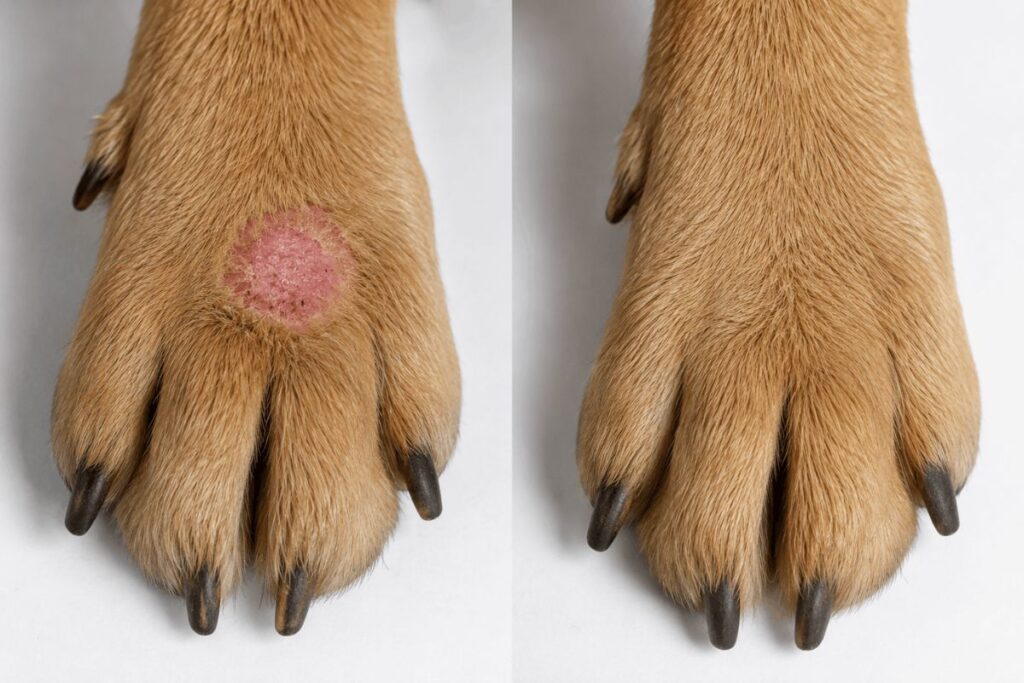
This is the question every worried dog owner needs answered. And here’s the honest truth — ringworm doesn’t look the same on every dog. That’s exactly what makes it so tricky.
The Classic Look: Circular Bald Patches
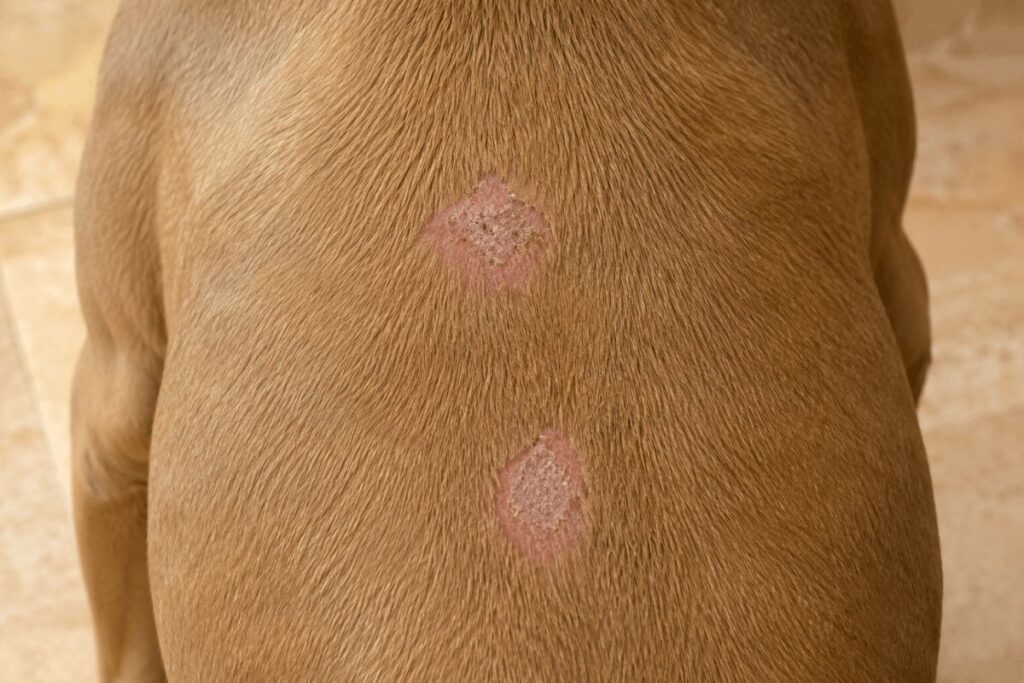
The most common appearance is small, circular patches of hair loss. The fur looks broken off at the base rather than cleanly shed. The skin underneath is often scaly, slightly red, and crusty around the edges. Some patches have a raised, inflamed border with a clearer center — this is what gives it the “ring” appearance in some cases.
Bella’s patch was about the size of a coin. The center looked almost like it was starting to heal while the outer edge was still active. My vet told me that’s actually a classic sign — the infection spreads outward as the center starts recovering.
Other Ways Ringworm Can Appear
Here’s where it gets interesting. Not all dogs get the textbook circular patch. Some cases look completely different.
| Appearance | What It Looks Like | Common In |
| Grey, scaly patch | Dull, dandruff-like scaling, minimal redness | Adult dogs, mild cases |
| Crusty bald spots | Rough, dry crusting over hair-loss area | Any dog, early-to-mid stage |
| Red inflamed lesion | Angry-looking red patch, swollen skin | Puppies, severe cases |
| Broken stubble fur | Fur snapped off at base, not shed | Long-haired breeds |
| Nail changes | Brittle, misshapen, crumbly nails | Less common but real |
| No visible signs | Dog is a carrier but shows nothing | Healthy adult dogs |
That last one surprises people. Some dogs carry and spread ringworm without ever showing a single symptom.
Ringworm Stages in Dogs — Early to Severe
Ringworm doesn’t appear overnight. It moves through stages, and catching it early makes treatment significantly faster and easier.
| Stage | Timeline | What You’ll See |
| Exposure & Incubation | Days 1–21 | No visible signs — fungus establishing itself |
| Early Lesion | Week 2–3 | Small circular hair-loss patch, slight redness |
| Active Spreading | Week 3–6 | Lesion grows outward, crusty border, more patches possible |
| Widespread Infection | Week 6+ untreated | Multiple lesions, intense itching, secondary bacterial infection |
| Healing (with treatment) | Week 6–12 | Hair regrowth, redness fading, center clearing first |
Most dog owners catch it in the early lesion or active spreading stage. If you’re seeing multiple patches across the body, the infection has been present for a while — that’s when vet treatment becomes non-negotiable.
Where on the Body Does Ringworm Appear?
Ringworm doesn’t show up randomly. It tends to appear in specific areas — usually the spots with thinner skin or where dogs come into contact with infected surfaces most often.
Most commonly affected areas: the face (around the eyes and muzzle), ears, paws and between the toes, the tail base, and the forelegs. In more severe cases it can spread across the back and belly.
It’s worth checking these areas carefully, especially after your dog has been around other dogs, been to a groomer, or spent time digging in soil.
Ringworm vs Other Dog Skin Conditions
This is the section most competitor blogs completely skip — and it’s the most useful thing for a worried dog owner. Ringworm looks a lot like several other conditions. Here’s how to tell them apart.
| Condition | Looks Like | Key Difference from Ringworm |
| Ringworm | Circular bald patch, crusty border, broken fur | Ring shape, spreads outward, responds to antifungal |
| Mange (Sarcoptic) | Intense itching, red crusty skin, hair loss | Caused by mites, extreme scratching, spreads faster |
| Mange (Demodectic) | Patchy hair loss, often on face/paws | Less itchy, mite-caused, usually in puppies |
| Hot Spots | Wet, oozing, red inflamed patch | Moist appearance, dog constantly licks it |
| Alopecia | Hair loss without redness or crusting | No infection signs, no spreading |
| Folliculitis | Small pustules, bumpy skin | Pus-filled bumps rather than dry patches |
The bottom line — if you’re not sure, don’t guess. A vet visit is the only way to confirm it.
How Ringworm Spreads — And Yes, It Can Spread to You
This part matters a lot, especially if you have kids or other pets at home. Ringworm is zoonotic — meaning it can jump from your dog to you and other animals. The fungal spores are genuinely resilient. They can survive on surfaces, furniture, carpets, and bedding for months.
Your dog can pick it up from direct contact with an infected animal, from grooming tools, shared bedding, towels, or even from soil outside. Once one dog in the house has it, check every other pet immediately.
If your dog is diagnosed, aim to quarantine them for around six weeks during treatment — I know that sounds daunting, but it genuinely prevents the infection from cycling through your whole household repeatedly.
How Vets Diagnose Ringworm in Dogs
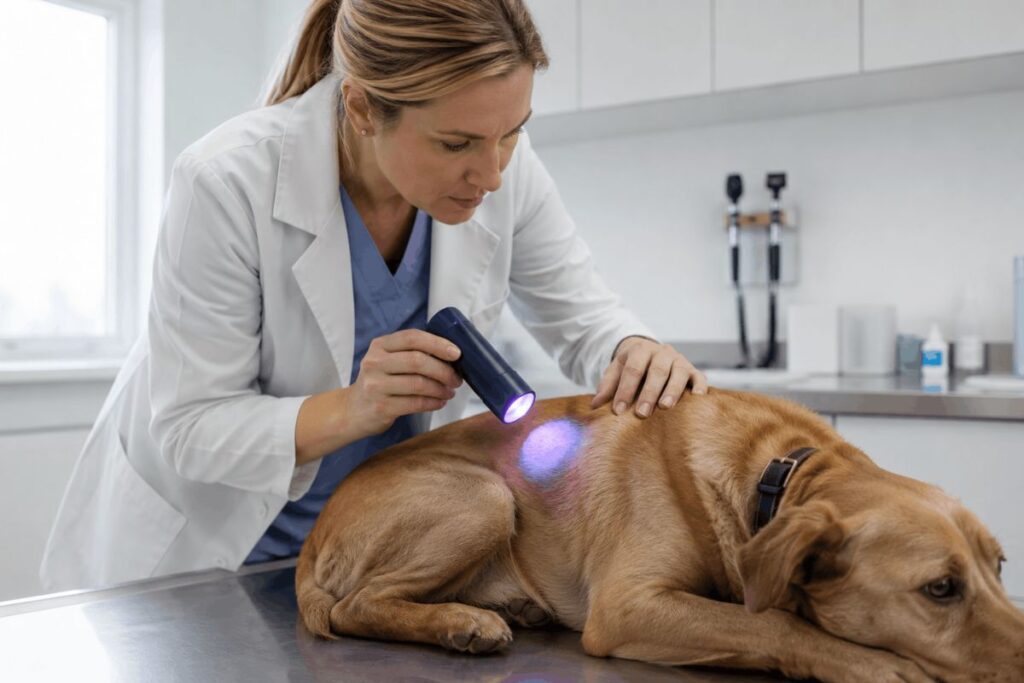
Your vet won’t just look at it and guess. There are specific tests used to confirm ringworm.
| Diagnostic Method | How It Works | Reliability |
| Physical Examination | Visual inspection of lesions and hair loss pattern | Useful but not definitive |
| Wood’s Lamp (UV Light) | Certain ringworm species glow green under UV light | Moderate — not all species fluoresce |
| Microscopic Examination | Hair/skin sample examined under microscope | Good — detects fungal spores |
| Fungal Culture | Sample grown in lab to identify exact fungus | Most accurate — takes 10 days |
Don’t be surprised if your vet runs two or three of these together. Ringworm genuinely looks like other conditions, and confirming it properly means the right treatment gets started faster. The Merck Veterinary Manual notes that fungal culture is the most reliable diagnostic method, though it can take up to 10 days for results.
Treatment Options for Dog Ringworm
The good news? Ringworm is very treatable. The not-so-good news is that treatment takes time — usually six weeks minimum, sometimes longer. Stopping early is the most common mistake dog owners make, and it almost always leads to the infection coming back.
Treatment typically involves three things working together:
Topical Treatment — medicated shampoos, creams, or lotions applied directly to the skin. These help prevent the infection spreading through the environment while treating the skin surface.
Oral Antifungal Medication — tablets or liquid medication that fights the fungus from the inside. Usually prescribed alongside topical treatment for faster results.
Home Decontamination — vacuuming daily, washing bedding in hot water, disinfecting floors and surfaces. The spores in your home will reinfect your dog if you skip this step.
Your vet may also recommend trimming the fur around affected areas — especially for long-haired dogs — to help the topical treatments reach the skin properly.
Frequently Asked Questions
Q: What does ringworm look like on a dog at first?
Early ringworm usually appears as a small circular patch of hair loss — about the size of a coin — with slightly red, scaly, or crusty skin underneath. The fur looks broken off, not shed.
Q: Is ringworm on dogs contagious to humans?
Yes. Ringworm is zoonotic, meaning it can spread from dogs to people through direct contact. Children, elderly people, and anyone with a weakened immune system are most at risk.
Q: How do I know if it’s ringworm or mange?
Mange causes intense, constant scratching and spreads much faster. Ringworm usually has a cleaner circular border and less severe itching. A vet test is the only reliable way to tell them apart.
Q: Where does ringworm most commonly appear on dogs?
Most commonly on the face, ears, paws, forelegs, and tail base. In severe cases it can spread across the back and belly.
Final Thoughts — What Does Ringworm Look Like on a Dog

Ringworm is one of those conditions that looks alarming but is very manageable when you catch it early. A circular bald patch, broken fur, crusty or scaly skin — especially on the face, paws, or legs — are your biggest warning signs. And if you’re ever unsure whether it’s ringworm or something else, trust your gut and call your vet.
Bella recovered fully within eight weeks. Her fur grew back completely and you’d never know it happened. Consistent treatment and keeping the house clean made all the difference.
If you spot anything suspicious on your dog’s skin, don’t wait. The sooner treatment starts, the faster and smoother the recovery.
For more helpful dog care tips, explore the rest of the Dog Wise Hub blog — your dog’s best friend online!